
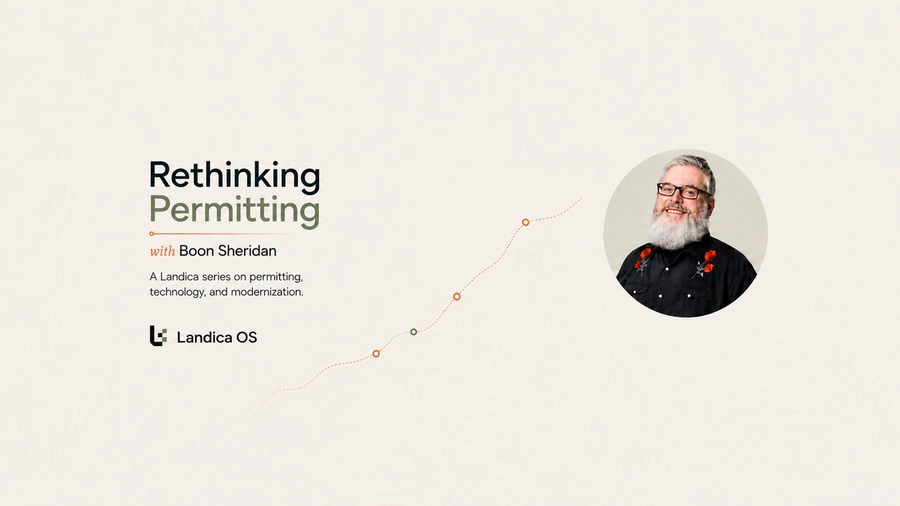
Over the past several months, we have spent a great deal of time talking with people inside and around the permitting system about what modernization should actually mean. One of the most useful of those conversations has been with Boon Sheridan, Permitting Technology Lead at the Environmental Policy Innovation Center (EPIC), whose recent work has focused on how people actually experience permitting and the technology intended to support them.
Before joining EPIC, Boon spent four years at 18F, much of that time working with the Council on Environmental Quality on permitting technology, and his research has included interviews with hundreds of NEPA practitioners, applicants, and technologists. (EPIC)
Our conversation with Boon moved well beyond a discussion of software. We talked about how agency staff work, how information moves between disciplines, what happens when experienced personnel leave, where artificial intelligence can realistically help, and why much of the permitting technology discussion still begins with an incomplete model of the problem. This article is the first in a four-part series exploring several ideas that came out of that conversation. The next articles will examine the limits of “one-shot” permitting automation, the idea of the project as the persistent container for information and context, and finally the distinction between workflow and orchestration.
The first issue is the most fundamental because it shapes how nearly everything else is designed: we continue to model permitting as a workflow when, in practice, much of the system operates through relationships.
Boon put the problem succinctly during our conversation:
It’s not a diagram, it’s relationships.
That distinction deserves considerably more attention than it receives.
The Workflow Is Real, but It Is Not the System
There is nothing inherently wrong with representing permitting as a workflow. Agencies need processes. Managers need to understand where projects sit. Applicants need to know what comes next. Congress and agency leadership need some way to measure performance. A complicated environmental review can be mapped into stages, milestones, responsible parties, consultations, deliverables, and decision points, and doing so can expose real problems.
The mistake is assuming that the resulting diagram is an accurate representation of the work itself.
A workflow might show an application moving from intake to land-status review, resource review, consultation, environmental analysis, and ultimately a decision. It can identify that a biologist, archaeologist, realty specialist, engineer, NEPA coordinator, or outside agency needs to participate at a particular point. What the workflow usually does not capture is how those people know what they need from one another, when an issue needs to be raised before its formal step arrives, who has dealt with the same problem before, why a particular piece of information matters, or how a decision made in one discipline may alter the work of another.
Those are not incidental details around the permitting process. They are part of the mechanism through which the process functions.
We have written previously about why permitting on federal land is structurally complex. A project can intersect land-use planning decisions, existing rights, habitat considerations, cultural resources, mineral interests, engineering requirements, multiple jurisdictions, and several statutory authorities at once. The consequence is that no single participant owns the complete problem. Each person holds a portion of the knowledge required to move the project forward.
A workflow can model the movement of work between those people. It does not necessarily model the knowledge required to move it.
That distinction becomes obvious at the field level. An experienced specialist may know that another program will not formally touch a project for six months, but also know that the work required at that stage includes a narrow field season. Waiting until the workflow reaches that person may technically follow the process and still leave the project months behind. Boon gave almost exactly this example in our conversation: if a specialist will need to be in the field in July, telling that person in May that July is now committed to a project is not meaningful planning. The dependency existed in January even if the formal task did not.
The workflow sees a July activity. The experienced employee sees a January dependency.
That difference matters.
The Invisible System Beneath the Formal Process
Calling permitting a relationship system can sound, at first, as though the argument is that government should operate through personal connections or informal favors. That is not the point.
The relationships that matter are professional relationships built around knowledge of responsibility, expertise, dependencies, precedent, timing, and trust. They exist because permitting is interdisciplinary and because no document can anticipate every interaction that will arise around a complex project.
An experienced employee knows more than the sequence of required reviews. They often know who owns a particular issue, which discipline should be brought in before a project becomes difficult, what another specialist will need in order to evaluate something, which office has encountered a similar problem, what went wrong the last time, when an external agency should be given advance notice, and which seemingly minor project change is likely to create consequences somewhere else.
None of this changes the law or substitutes for the formal decision-making process. It makes the formal process workable.
The federal permitting system itself recognizes the importance of this connective activity. The Permitting Council's FY 2024 performance report repeatedly emphasizes cross-agency engagement, communication, relationship building, training, issue resolution, and coordination among the federal entities involved in infrastructure permitting. It also identifies limited project-management skillsets and challenges integrating improved practices into agency processes. (Permitting Council FY 2024 Performance Report)
The important point is not that relationships are preferable to formal systems. It is that relationships have historically compensated for what the formal systems do not contain.
An experienced practitioner recognizes the gap and fills it. They make the call, forward the document, explain the history, warn someone that an issue is coming, or know enough about another discipline to ask the right question before the project reaches it.
From the outside, that activity is easy to miss because it rarely appears as the consequential step on a permitting schedule. Yet without it, a technically correct workflow can still perform badly.
Institutional Knowledge Is Not Just Information We Forgot to Write Down
This leads to another problem in the permitting discussion: institutional knowledge is often treated as though it were simply a collection of undocumented procedures.
The proposed solution is therefore documentation. Write the manual. Build the standard operating procedure. Create the knowledge base. Record the training. Those are important measures, particularly as agencies manage workforce transitions, but they only capture part of what experienced employees carry.
As we argued in The Burden We Don't See: What Agencies Actually Face in Permitting, much of the practical capacity of permitting organizations resides in people rather than in systems. Experienced personnel accumulate an understanding of how formal direction is actually applied, which issues matter at different stages, how local conditions affect interpretation, and what another discipline is likely trying to resolve when it asks for additional information.
But there is an additional layer.
Institutional knowledge is not merely undocumented information. Much of it is accumulated understanding of relationships, dependencies, timing, precedent, and context.
A manual can tell a new employee that consultation with another agency may be required under a particular condition. The manual is much less likely to tell them which office should be contacted first, who has historically handled that issue, what information will make that first conversation productive, whether a similar project has already established useful precedent, which internal specialist has relevant experience, or what needs to happen now to avoid creating a problem six months later.
That is the difference between knowing a requirement and knowing how to operate within a system.
It is also why the current workforce transition matters to permitting in ways that simple staffing counts cannot describe. OPM reports that the federal Deferred Resignation Program introduced in 2025 ultimately resulted in approximately 154,000 voluntary resignations across the federal workforce. Interior guidance from the same period explicitly addressed employees participating in Deferred Resignation and Voluntary Early Retirement programs. Those figures are not a measure of how many permitting specialists left federal service, and they should not be treated as one. They do, however, illustrate the scale of the organizational transition agencies have been navigating. (OPM; Department of the Interior)
When an experienced employee leaves, the organizational impact cannot be represented simply as FTE: -1.
The agency may also lose twenty years of accumulated project history, working relationships, local understanding, procedural instincts, and knowledge about how one part of the organization interacts with another. Some of that knowledge can be documented. Some can be transferred through training. Some of it disappears because the organization never had a mechanism for capturing it in the first place.
That is not merely a staffing problem. It is an institutional resilience problem.
Where the Permitting Reform Conversation Falls Short
The permitting reform conversation is not unaware of technology, coordination, or workforce challenges. In fact, current federal initiatives are substantially more sophisticated than the simplistic idea of putting an application online and building a dashboard.
The April 2025 presidential memorandum on Updating Permitting Technology for the 21st Century directed agencies to eliminate paper processes, reduce duplicative data submissions, increase interagency use of existing analyses, reduce coordination friction, and move toward interconnected agency systems and shared services. CEQ's subsequent Permitting Technology Action Plan established minimum functional requirements, a permitting data and technology standard, an implementation roadmap, and an interagency governance structure.
That is meaningful progress. In June 2026, the Permitting Council announced more than $14 million for three federal permitting technology projects intended to advance that modernization agenda. (Permitting Council)
The criticism, then, should not be that the federal government is ignoring modernization. The more important question is whether we have developed a sufficiently complete model of the work being modernized.
Permitting reform naturally gravitates toward what can be measured and standardized. How long did a review take? Which milestone is late? Who owns the next task? How quickly can an application move between agencies? Can a document be generated automatically? Can two systems exchange the same data? These are legitimate questions, and improvements in any of these areas can produce real value.
But another question deserves equal attention:
Does the person responsible for the next decision have the context, information, and connections necessary to make it?
That is not the same design problem.
Boon made this point from the perspective of the people performing the work. Agencies are not populated by generic project resources waiting for a task assignment. They are populated by fish biologists, archaeologists, geologists, engineers, planners, realty specialists, and other professionals whose responsibility is to exercise expertise within a particular domain. Talking to them as though their role is simply to move a project from one box to another misunderstands why they are in the process in the first place.
His alternative is deceptively simple: instead of beginning with “What is your workflow?”, ask whether someone has enough information to make the decision in front of them. If the answer is no, ask what is missing and where it comes from.
That line of inquiry reveals a very different system.
It shifts attention from sequence to dependency, from tasks to information, and from process compliance to what people actually need to perform their work.
The Old System Was Fragile, but It Was Doing Something Important
None of this is an argument for preserving a permitting system dependent on personal memory and informal relationships. Quite the opposite.
A relationship-dependent operating model has serious weaknesses. New employees do not inherit twenty years of context on their first day. Offices can develop different practices. Important information can become trapped in email chains, shared drives, paper files, or individual memory. An employee departure can create a hole that nobody realizes exists until a project reaches the point where that person's knowledge would have mattered.
The old system could tolerate poor information architecture because experienced people compensated for it.
They remembered the previous project. They knew whom to call. They knew where the document was. They had worked with the other agency before. They recognized that the issue on page 80 of an application was going to matter to someone who had not yet seen it. They understood that an apparently isolated decision had consequences elsewhere.
That is simultaneously one of the strengths and one of the greatest vulnerabilities of the current system.
The modernization opportunity is therefore not to preserve dependence on relationships. It is to understand what those relationships were supplying before we design systems that assume they are unnecessary.
This is particularly important because the technology market is no longer short of permitting tools. Boon’s 2026 permitting technology landscape analysis cataloged more than 300 tools across government and the private sector and found that more than three-quarters had some form of API capability. His conclusion was that the persistent problem is not simply the absence of technology, but the inability of those tools and organizations to operate as a coherent system. (EPIC, We Have a Tool for Everything, But a System for Nothing)
That diagnosis should influence what gets built next.
Technology Should Preserve Context, Not Try to Replace Relationships
A modern permitting system should not attempt to digitize human relationships. Nor should it try to automate professional judgment out of the process. It should make the context that allows those relationships and judgments to function more durable, accessible, and transferable.
If a specialist becomes involved in a project, the organization should be able to understand why. If another agency requests information, that request should remain connected to the issue that produced it. If a project changes direction because of a resource concern, the reasoning and downstream dependencies should not disappear into an email chain. If a similar issue was resolved five years earlier, the next employee should have some way to discover that history without knowing which former employee to call.
Over time, a better system should preserve a coherent record of who participated, why they participated, what information they needed, what decisions followed, which dependencies were created, and what prior context informed the work.
The objective is not surveillance, and it is not the indiscriminate capture of every human interaction. It is organizational memory.
When an experienced employee retires after decades of service, their replacement should inherit more than a list of open case numbers and a directory full of documents. The institution should retain as much appropriately recordable context as possible about how those projects arrived where they are, what matters next, and how the pieces relate to one another.
That is how technology begins to reduce the fragility created when institutional knowledge lives almost entirely in individuals.
It also changes the role of software. The system is no longer just recording that Task A was completed and Task B is next. It begins helping people understand why Task B exists, what Task B depends upon, what information is available to perform it, and what other parts of the project may be affected by its outcome.
That is a much more ambitious objective than workflow digitization, but it is also much closer to the reality of permitting.
Before We Automate Permitting, We Need to Understand What We Are Automating
There is enormous pressure to make federal permitting faster, and much of that pressure is justified. Infrastructure needs to be built. Agencies need better tools. Applicants need greater predictability. Staff should not spend their careers recreating information that already exists or navigating systems that make straightforward work unnecessarily difficult.
But speed is not a substitute for understanding the operating model.
If we represent permitting primarily as a sequence of tasks, we will naturally build technology optimized to move tasks faster. We may produce better dashboards, tighter schedules, cleaner handoffs, and more automated documents while leaving untouched the less visible system that determines whether the people performing those tasks actually have what they need.
The workflow describes what is supposed to happen.
The relationship system explains how much of it actually happens.
The goal of modernization should not be to preserve the informal system indefinitely. It should be to understand what information, context, dependencies, and institutional memory that system has historically carried, and then make more of that knowledge durable at the organizational level.
Only then can we begin asking the next question: how much of this work can technology actually perform?
In Part II of Rethinking Permitting with Boon Sheridan, we will examine what Sheridan called the “one-shot” problem: how far AI and automation can realistically get when asked to evaluate a permitting problem from the information available, where those systems begin to fail, and what those failures can teach us about the information architecture underneath permitting itself.